








Clinical Studies References
Glutathione is a powerful antioxidant. It is water-soluble and is primarily synthesized in the liver. It is involved in DNA synthesis and repair, protein and prostaglandin synthesis, amino acid transport, metabolism of toxins and carcinogens, immune system function, prevention of oxidative cell damage and enzyme activation. Cellular glutathione levels increase during exercise. Glutathione deficiency is associated with aging, age-related macular degeneration (AMD), diabetes, lung and gastrointestinal disease, pre-eclampsia, Parkinson's disease, other neurodegenerative disorders and poor prognosis in AIDS. Glutathione may inhibit the activity of enzymes that help the flu virus colonize cells lining the mouth and throat. Flu-infected mice fed glutathione-enriched drinking water have lower tissue virus levels than untreated mice. Human studies are needed to determine the effects on flu infection.
Although Glutathione is present in fruits, vegetables and meats, the levels in the body do not seem to correlate to dietary intake. Your body synthesizes Glutathione primarily from L-Cysteine which acts as a precursor. However, L-Cysteine is quite unstable, which is why we have always used the more effective and expensive, but stable form of Acetyl-L-Cysteine to help the body produce L-Glutathione.
Some people still cannot effectively synthesize the precursors and end up with a shortage of L-Glutathione in their cells, which leads to all sorts of health complications and premature aging. Researchers have found that most patients suffering from disease have lower than normal levels of L-Glutathione in their cells.
Because depletion of L-Glutathione has been noted in so many diseases many researchers throughout the world worked on ways of trying to figure out how to replenish L-Glutathione in the cells. This was a very difficult task as 'normal' L-Glutathione is ineffective when taken orally... for two reasons. One... the molecule is too large to pass through the cell membranes and two... it is useless if released into the stomach as per normal capsules and tablets!
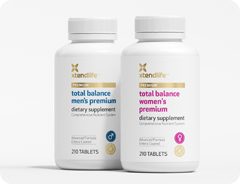
Scientists ultimately figured out how to make the molecule smaller so it could pass through the cell membranes. Reduced Glutathione, such as we use in our Total Balance formula, is well absorbed by the body. It is able to benefit you in all the same ways as Glutathione, but is additionally important as it helps to increase and maintain the functions of other antioxidants. For example, as a ‘ground’ for antioxidant enzyme activity such as for Glutathione peroxidase (a powerful enzyme and scavenger of free radicals, which defuses damaging peroxides (formed by the oxidation of lipids and further causing rancidity).
So, this solved the first problem! This meant that there was only the one outstanding issue of how to get the Glutathione to the cells. It cannot be released in the stomach because the stomach acid would destroy it. It needs to be released in the upper intestine, where it can be safely and wholly absorbed.
Fortunately the technology to achieve this has been used in the pharmaceutical industry for some time. It is called enteric coating, and Xtend-Life has employed this technique in the manufacturing process, without having to increase costs onto the consumer. For more info on enteric coating please
back to top
Published Clinical Studiesclin L-Glutathione
Regulation of glutathione in inflammation and chronic lung diseases.1
Department of Environmental Medicine, Division of Lung Biology and Disease Program, University of Rochester Medical Center, P.O. Box 850, 601 Elmwood Ave., Rochester, NY 14642, USA.
Oxidant/antioxidant imbalance, a major cause of cell damage, is the hallmark for lung inflammation. Glutathione (GSH), a ubiquitous tripeptide thiol, is a vital intra- and extra-cellular protective antioxidant against oxidative stress, which plays a key role in the control of signaling and pro-inflammatory processes in the lungs. The rate-limiting enzyme in GSH synthesis is glutamylcysteine ligase (GCL). GSH is essential for development as GCL knock-out mouse died from apoptotic cell death. The promoter (5'-flanking) region of human GCL is regulated by activator protein-1 (AP-1) and antioxidant response element (ARE), and are modulated by oxidants, phenolic antioxidants, growth factors, inflammatory and anti-inflammatory agents in various cells. Recent evidences have indicated that Nrf2 protein, which binds to the erythroid transcription factor (NF-E2) binding sites, and its interaction with other oncoproteins such as c-Jun, Jun D, Fra1 and Maf play a key role in the regulation of GCL. Alterations in alveolar and lung GSH metabolism are widely recognized as a central feature of many chronic inflammatory lung diseases. Knowledge of the mechanisms of GSH regulation could lead to the pharmacological manipulation of the production and/or gene transfer of this important antioxidant in lung inflammation and injury. This article describes the role of AP-1 and ARE in the regulation of cellular GSH biosynthesis and assesses the potential protective and therapeutic role of glutathione in oxidant-induced lung injury and inflammation.
PMID: 16054171 [PubMed - as supplied by publisher]
back
Glutathione metabolism and its implications for health.2
Faculty of Nutrition, Texas A&M University, College Station, TX, 77843, USA. g-wu@tamu.edu
Glutathione (gamma-glutamyl-cysteinyl-glycine; GSH) is the most abundant low-molecular-weight thiol, and GSH/glutathione disulfide is the major redox couple in animal cells. The synthesis of GSH from glutamate, cysteine, and glycine is catalyzed sequentially by two cytosolic enzymes, gamma-glutamylcysteine synthetase and GSH synthetase. Compelling evidence shows that GSH synthesis is regulated primarily by gamma-glutamylcysteine synthetase activity, cysteine availability, and GSH feedback inhibition. Animal and human studies demonstrate that adequate protein nutrition is crucial for the maintenance of GSH homeostasis. In addition, enteral or parenteral cystine, methionine, N-acetyl-cysteine, and L-2-oxothiazolidine-4-carboxylate are effective precursors of cysteine for tissue GSH synthesis. Glutathione plays important roles in antioxidant defense, nutrient metabolism, and regulation of cellular events (including gene expression, DNA and protein synthesis, cell proliferation and apoptosis, signal transduction, cytokine production and immune response, and protein glutathionylation). Glutathione deficiency contributes to oxidative stress, which plays a key role in aging and the pathogenesis of many diseases (including kwashiorkor, seizure, Alzheimer's disease, Parkinson's disease, liver disease, cystic fibrosis, sickle cell anemia, HIV, AIDS, cancer, heart attack, stroke, and diabetes). New knowledge of the nutritional regulation of GSH metabolism is critical for the development of effective strategies to improve health and to treat these diseases.
Publication Types:
PMID: 14988435 [PubMed - indexed for MEDLINE]
Nutritional regulation of glutathione in stroke.3
College of Pharmacy and Nutrition, The Cameco MS Neuroscience Research Center, University of Saskatchewan, 110 Science Place, Saskatoon, SK S7N 5C9, Canada. patersnp@duke.usask.ca
In contrast to cardiovascular disease, the impact of nutritional status on the prevention and outcome of stroke has received limited investigation. We present a mechanism based on animal studies, clinical data, and epidemiological data by which protein-energy status in the acute stroke and immediate postinjury periods may affect outcome by regulating reduced glutathione (GSH), a key component of antioxidant defense. As cysteine is the limiting amino acid for GSH synthesis, the GSH concentration of a number of nonneural tissues has been shown to be decreased by fasting, low-protein diets, or diets limiting in sulfur amino acids. The mechanism may also be relevant in brain since GSH in some brain regions is responsive to dietary sulfur amino acid supply and to the pro-cysteine drug, L-2-oxothiazolidine-4-carboxylate. The latter is an intracellular cysteine delivery system used to overcome the toxicity associated with cysteine supplementation. These findings may provide the mechanism to explain both the inverse correlation between dietary protein and stroke mortality and the documented association between suboptimal protein-energy status and diminished functional status following a stroke. Future investigations should examine the role of nutritional intervention in neuroprotective strategies aimed at improving stroke outcome. Pharmacological interventions such as L-2-oxothiazolidine-4-carboxylate should be investigated in animal models of stroke, as well as the impact of nutritional status on the response to these agents. Finally, micronutrient deficiencies that may accompany protein-energy malnutrition, such as selenium, should also be investigated for their role in antioxidant defense in cerebral ischemia.
PMID: 12835106 [PubMed]
Nutrition and ageing.4
Department of Biotechnology, University of Alicante, Denia, Spain. renc@lycosmail.com
The reviewed literature indicates that, even in industrialised countries, the nutrition of mature and aged subjects is often inadequate (because of deficiency or excess), which may lead to premature or pathological senescence. Recent nutritional research on ageing laboratory animals shows that dietary restriction may be the most effective procedure to achieve a long and disease-free life span, probably owing to a better protection against mitochondria-linked oxygen stress. Likewise, the experimental and clinical work from many laboratories, including our own, indicates that age-dependent changes in the cardiovascular and immune systems are linked to oxygen stress and that an adequate intake of dietary antioxidants may protect those systems against chronic degenerative syndromes in the physiopathology of which reactive oxygen species (ROS) play a key role. The extant data indicate that the antioxidant vitamins C and E are centrally involved in defending the above two systems against ROS attack. Moreover, recent research suggests that the glutathione-related thiolic antioxidants, thiazolidine carboxylic acid (thioproline) and N-acetylcysteine, as well as the phenolic liposoluble 'co-antioxidants' of Curcuma longa, may have a significant protective effect against age-related atherogenesis and immune dysfunction. Key messages from this paper are the following. (1) It is generally accepted that oxygen free radicals released in metabolic reactions play a key role in the physiopathology of 'normal ageing' and of many age-related degenerative diseases. (2) Consumption of adequate levels of antioxidants in the diet is essential in order to preserve health in old age. (3) A certain degree of protection against atherogenesis and immune dysfunction may be achieved by preventing vitamin E deficiency and an excessive oxidation of the glutathione-supported thiol pool.
PMID: 11918486 [PubMed - indexed for MEDLINE]
Redox control of the transsulfuration and glutathione biosynthesis pathways.5
Division of Nutritional Sciences, Department of Animal Sciences, University of Illinois at Urbana-Champaign, 1207 W. Gregory Drive, Urbana, IL 61801, USA.
Intracellular reduction-oxidation status is increasingly recognized as a primary regulator of cellular growth and development. The relative reduction-oxidation state of the cell depends primarily on the precise balance between concentrations of reactive oxygen species and the cysteine-dependent antioxidant thiol buffers glutathione and thioredoxin, which by preferentially reacting with reactive oxygen species, protect other intracellular molecules from oxidative damage. The transsulfuration pathway constitutes the major route of cysteine biosynthesis, and may thus be central in controlling the intracellular reduction-oxidation state and the balance between self-renewal and differentiation programs. This review discusses new findings on reciprocal reduction-oxidation modulation of enzymes involved in the transsulfuration and glutathione biosynthesis pathways, as well as studies elucidating the impact of sulfur amino acid availability on these pathways.
PMID: 11790955 [PubMed - indexed for MEDLINE]
6 Glutathione deficiency intensifies ischaemia-reperfusion induced cardiac dysfunction and oxidative stress.
Department of Kinesiology and Nutritional Science, University of Wisconsin-Madison, WI, USA.
The efficacy of glutathione (GSH) in protecting ischaemia-reperfusion (I-R) induced cardiac dysfunction and myocardial oxidative stress was studied in open-chest, stunned rat heart model. Female Sprague-Dawley rats were randomly divided into three experimental groups: (1) GSH-depletion, by injection of buthionine sulphoxamine (BSO, 4 mmol kg(-1), i.p.) 24 h prior to I-R, (2) BSO injection (4 mmol kg(-1), i.p.) in conjunction with acivicin (AT125, 0.05 mmol kg(-1), i.v.) infusion 1 h prior to I-R, and (3) control (C), receiving saline treatment. Each group was further divided into I-R, with surgical occlusion of the main left coronary artery (LCA) for 30 min followed by 20 min reperfusion, and sham. Myocardial GSH content and GSH : glutathione disulphide (GSSG) ratio were decreased by approximately 50% (P < 0.01) in both BSO and BSO + AT125 vs. C. Ischaemia-reperfusion suppressed GSH in both left and right ventricles of C (P < 0.01) and left ventricles of BSO and BSO + AT125 (P < 0.05). Contractility (+dP/dt and -dP/dt) in C heart decreased 55% (P < 0.01) after I and recovered 90% after I-R, whereas +/-dP/dt in BSO decreased 57% (P < 0.01) with ischaemia and recovered 76 and 84% (P < 0.05), respectively, after I-R. For BSO + AT125, +/-dP/dt were 64 and 76% (P < 0.01) lower after ischaemia, and recovered only 67 and 61% (P < 0.01) after I-R. Left ventricular systolic pressure in C, BSO and BSO + AT125 reached 95 (P > 0.05) 87 and 82% (P < 0.05) of their respective sham values after I-R. Rate-pressure double product was 11% (P > 0.05) and 25% (P < 0.05) lower in BSO and BSO + AT125, compared with Saline, respectively. BSO and BSO + AT125 rats demonstrated significantly lower liver GSH and heart Mn superoxide dismutase activity than C rats after I-R. These data indicate that GSH depletion by inhibition of its synthesis and transport can exacerbate cardiac dysfunction inflicted by in vivo I-R. Part of the aetiology may involve impaired myocardial antioxidant defenses and whole-body GSH homeostasis.
PMID: 11437734 [PubMed - indexed for MEDLINE]
8 A short review on the role of glutathione in the response of yeasts to nutritional, environmental, and oxidative stresses.
Laboratoire de Physiologie et Ecologie Microbiennes, Universite Libre de Bruxelles c/o IP. 642, Rue Engeland. B-1180, Brussels, Belgium.
Glutathione (L-gamma-Glutamyl-L-Cysteinylglycine) appears as the major nonprotein thiol compound in yeasts. Recent advances have shown that glutathione (GSH) seems to be involved in the response of yeasts to different nutritional and oxidative stresses. When the yeast Saccharomyces cerevisiae is starved for sulfur or nitrogen nutrients, GSH may be mobilized to ensure cellular maintenance. Glutathione S-transferases may be involved in the detoxification of electrophilic xenobiotics. Vacuolar transport of metal derivatives of GSH ensure resistance to metal stress. Growth of methylotrophic yeasts on methanol results in the formation of an excess formaldehyde that is detoxified by a GSH-dependent formaldehyde dehydrogenase. Growth of yeasts on glycerol results in the accumulation of methylglyoxal detoxified by the glyoxalase pathway. Glutathione per se can react with oxidative agents or is involved in the oxidative stress response through glutathione peroxidase.
PMID: 10862879 [PubMed - as supplied by publisher]
Male infertility: nutritional and environmental considerations.9
Green Valley Health, Hagerstown, MD 21742, USA.
Studies confirm that male sperm counts are declining, and environmental factors, such as pesticides, exogenous estrogens, and heavy metals may negatively impact spermatogenesis. A number of nutritional therapies have been shown to improve sperm counts and sperm motility, including carnitine, arginine, zinc, selenium, and vitamin B-12. Numerous antioxidants have also proven beneficial in treating male infertility, such as vitamin C, vitamin E, glutathione, and coenzyme Q10. Acupuncture, as well as specific botanical medicines, have been documented in several studies as having a positive effect on sperm parameters. A multi-faceted therapeutic approach to improving male fertility involves identifying harmful environmental and occupational risk factors, while correcting underlying nutritional imbalances to encourage optimal sperm production and function.
PMID: 10696117 [PubMed - indexed for MEDLINE]
Glutathione status in critically-ill patients: possibility of modulation by antioxidants.10
Department of Anaesthesia and Intensive Care, KFC, Huddinge Hospital, Stockholm, Sweden. Jan.Wernerman@anaesth.hs.sll.se
Muscle tissue serves as a protein reservoir which is mobilized to meet the specific metabolic needs associated with various catabolic conditions in human subjects, such as trauma and critical illness. Glutathione is one of the most abundant short-chain peptides and a major source of non-protein thiol in the body, and tissue glutathione concentration is related to its oxidative capacity. Skeletal muscle is relatively unique with respect to a variety of metabolic properties, such as oxidative potential, patterns of amino acid utilization, and antioxidant enzyme activity. The glutathione concentration is not influenced by food intake, or by food deprivation. Moreover, there is no diurnal variation on muscle glutathione levels. Following elective surgery the muscle concentration of GSH (the reduced form) decreases by 40% 24 h post-operatively, while the concentration of GSSG (the oxidized form) remains unaltered. During critical illness a similar decrease in the GSH concentration is seen, but in addition a change in the redox status indicative of an elevated GSSG level occurs. Furthermore, correlations between the concentrations of glutamine as well as glutamate and GSH exist in these patients. From available evidence accumulated it is clear that glutathione plays a pivotal role in the maintenance of the intracellular redox status, the antioxidant vitamin levels, and the antioxidant enzyme functions under various metabolic conditions. The effectiveness of glutathione protection in the individual tissue depends on the tissue concentration of glutathione as well as the capacity of the tissue to import GSH and to export GSSG. The mechanisms by which catabolism regulates tissue glutathione levels and the enzyme activities associated with the gamma-glutamyl cycle are not completely understood and further studies need to be conducted.
PMID: 10604202 [PubMed - indexed for MEDLINE]
12 Low levels of glutathione in endoscopic biopsies of patients with Crohn's colitis: the role of malnutrition.
GBPDN and GRAD, Rouen University Hospital, 1, rue de Germont, Rouen Cedex, 76031, France.
BACKGROUND AND AIMS: During active Crohn's disease, generation of free radicals is increased, and nutritional depletion is frequent. We investigated the glutathione concentration of the colonic mucosa in biopsies from patients with active Crohn's colitis depending on nutritional status. METHODS: Endoscopic biopsies were taken in 10 well-nourished control patients, and 18 patients with active Crohn's disease (11 well-nourished, seven malnourished with a recent weight loss > 10 %). Colonic biopsies were taken from healthy and inflamed mucosa and analysed for total glutathione concentration. RESULTS: Mucosal glutathione concentration (nmol/mg wet tissue) was lower in patients with active colitis both in diseased and healthy mucosa as compared with controls (1.89 +/- 0.39, 2.08 +/- 0.4 and 6.69 +/- 4. 94, respectively, P< 0.05). Mucosal glutathione was lower in healthy mucosa from malnourished versus well-nourished patients: 1.8 +/- 0.2 vs 2.3 +/- 0.37 (P= 0.02). CONCLUSIONS: Mucosal glutathione is markedly lower in active Crohn's colitis, even in healthy mucosa; glutathione depletion tends to be more severe in malnourished patients. Glutathione depletion may be related in part to malnutrition and contribute to a prolonged evolution of disease and could be a target for pharmacological and nutritional support.
PMID: 10601540 [PubMed - indexed for MEDLINE]
Referencesref